
Environmental, Social, and Governance (ESG) reporting is no longer optional for many UK organisations. Whether driven by regulation, investor expectations, or client requirements, the pressure to report transparently on environmental performance is increasing year on year.
Washroom services might seem like a small line item, but for multi-site organisations they represent a measurable waste stream with genuine carbon implications. Including washroom data in your ESG reporting demonstrates thoroughness and can contribute meaningfully to your environmental narrative.
Here is how to do it properly.
What ESG Reporting Covers
ESG reporting frameworks vary, but the environmental component typically requires organisations to disclose data on:
- Carbon emissions — Scope 1 (direct), Scope 2 (purchased energy), and increasingly Scope 3 (supply chain and indirect)
- Waste generation and disposal — volumes, methods, and diversion rates
- Resource consumption — water, energy, and raw materials
- Circular economy practices — reuse, recycling, and waste prevention initiatives
Washroom services touch on several of these areas. The waste generated by sanitary bins, nappy bins, clinical waste, and other washroom streams is part of your overall waste footprint. How that waste is transported and processed contributes to your Scope 3 emissions.
Where Washroom Services Fit
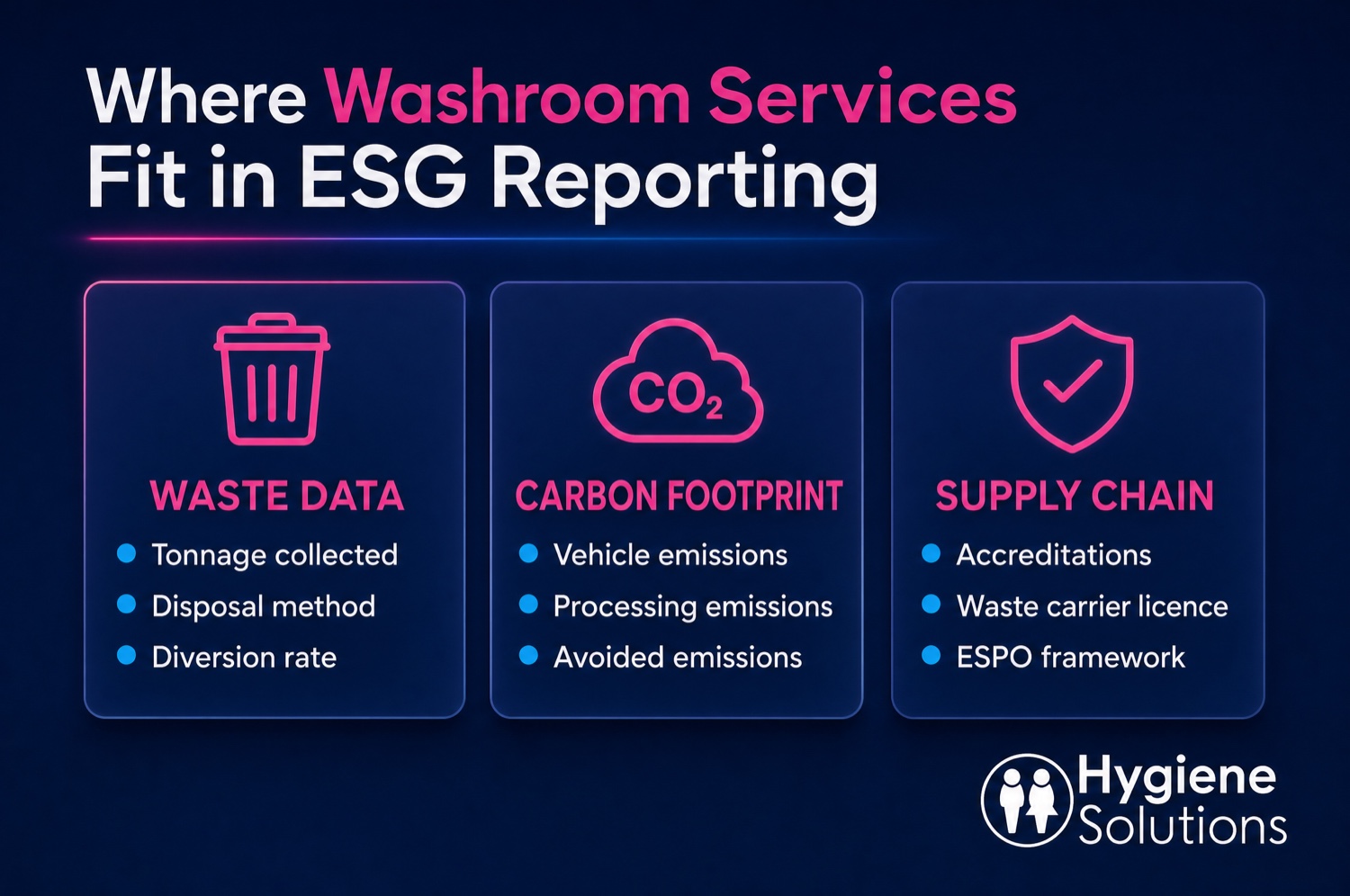
Waste data
Every washroom service visit generates waste data that can feed into your ESG reporting:
- Tonnage collected — the total weight of washroom waste removed from your premises
- Disposal method — whether waste is recycled, incinerated (recovery), or sent to landfill
- Waste hierarchy level — the position on the legally defined waste hierarchy at which your waste is processed
- Diversion rate — the percentage of waste diverted from landfill
If your provider can demonstrate genuine zero-to-landfill processing with a named facility, your diversion rate and the quality of your duty of care reporting will be stronger.
Carbon footprint
Washroom services contribute to your Scope 3 carbon emissions in several ways:
- Collection vehicle emissions — the fuel consumed by service vehicles travelling to your sites
- Processing emissions — the energy and emissions associated with waste treatment
- Avoided emissions — if waste is recycled rather than incinerated or landfilled, you can report on the emissions avoided compared to less sustainable methods
Calculating these figures requires data from your provider. A good provider will supply this proactively.
Supply chain credentials
The governance element of ESG increasingly includes supply chain due diligence. Reporting on your washroom services provider’s credentials demonstrates responsible procurement:
- Accreditations — ISO 9001, Safe Contractor, CHAS, and similar standards
- Framework membership — procurement through recognised frameworks such as ESPO shows due diligence
- Waste carrier licences — confirmation that your provider holds the necessary Environment Agency permits
- Modern slavery statement — larger providers should have a published statement under the Modern Slavery Act
Eco Impact Reports
An Eco Impact Report is a document provided by your washroom services supplier that summarises the environmental data from your contract. At Hygiene Solutions, our Eco Impact Reports include:
- Total waste tonnage collected across the reporting period
- Landfill diversion — confirmation that 100% of washroom waste is diverted from landfill
- Carbon data — the CO2 equivalent associated with collection and processing
- Collections data — number of service visits, sites covered, and service types
- Compliance documentation — summary of duty of care waste transfer notes issued
This data can be incorporated directly into your ESG report. If you are reporting against a specific framework (such as GRI, TCFD, or SECR), the Eco Impact Report provides the raw data you need for the relevant disclosure sections.
Requesting an Eco Impact Report
If your current provider does not offer Eco Impact Reports, ask for one. Any reputable provider should be able to supply:
- Total tonnage collected for your organisation
- The name and licence details of the processing facility
- Confirmation of the waste hierarchy level achieved
- Carbon calculations based on their processing method
If they cannot provide this information, it raises questions about transparency and whether the waste is being processed as claimed.
Carbon Footprint Calculation
For organisations that want to include washroom services in their carbon footprint calculations, here is a simplified methodology:
Step 1: Gather your data
From your provider, you need:
- Total waste tonnage collected (in kg or tonnes)
- Disposal method (recycling, incineration, or landfill)
- Distance travelled for collections (approximate, based on depot-to-site routes)
Step 2: Apply emission factors
DEFRA publishes annual greenhouse gas conversion factors for UK organisations. The relevant factors for washroom waste include:
- Waste disposal emissions — different factors for recycling, incineration, and landfill (measured in kg CO2e per tonne of waste)
- Transport emissions — based on vehicle type and distance (measured in kg CO2e per km)
Step 3: Calculate and report
Multiply your tonnage by the appropriate DEFRA factor for your disposal method. Add transport emissions based on estimated collection distances. The result is your washroom services carbon contribution in kg CO2e.
For most organisations, washroom services represent a small but reportable portion of Scope 3 emissions. Including it demonstrates thoroughness and a commitment to comprehensive environmental accounting.
Supplier Credentials to Check
When evaluating your washroom services provider through an ESG lens, here are the key credentials to verify:
- ISO 9001 — quality management system certification
- Safe Contractor / CHAS — health and safety accreditation
- Environment Agency waste carrier licence — legally required for anyone transporting waste
- Named processing facility — you should know where your waste goes
- DBS checks — required if the provider services school or education premises
- Insurance — public liability, employer’s liability, and environmental impairment cover
- Modern slavery statement — for providers meeting the turnover threshold
At Hygiene Solutions, we hold ISO 9001 accreditation, Safe Contractor approval, and we are approved on the ESPO Framework 239_20. We provide Eco Impact Reports to all clients as standard, and our washroom waste is diverted 100% from landfill and processed into Solid Recovered Fuel through our Go 4 Greener partnership.
Getting Started
If you are looking to strengthen the washroom services component of your ESG reporting, here is a practical action plan:
- Request current data — ask your provider for tonnage, disposal method, and carbon figures for the last 12 months
- Check credentials — verify accreditations, licences, and waste destination
- Ask for an Eco Impact Report — if one is not provided automatically, request it
- Compare against the waste hierarchy — is your waste being recycled or incinerated?
- Audit your provision — a free washroom site survey can assess your entire washroom operation and identify opportunities for improvement
Washroom services may be a small part of your overall environmental footprint, but they are a measurable, improvable, and reportable part. Getting the data right demonstrates the kind of thorough, transparent approach that ESG stakeholders value.
For help with Eco Impact Reports, compliance documentation, or a free audit of your current washroom provision, contact Hygiene Solutions on 0800 389 8124 or book online.