
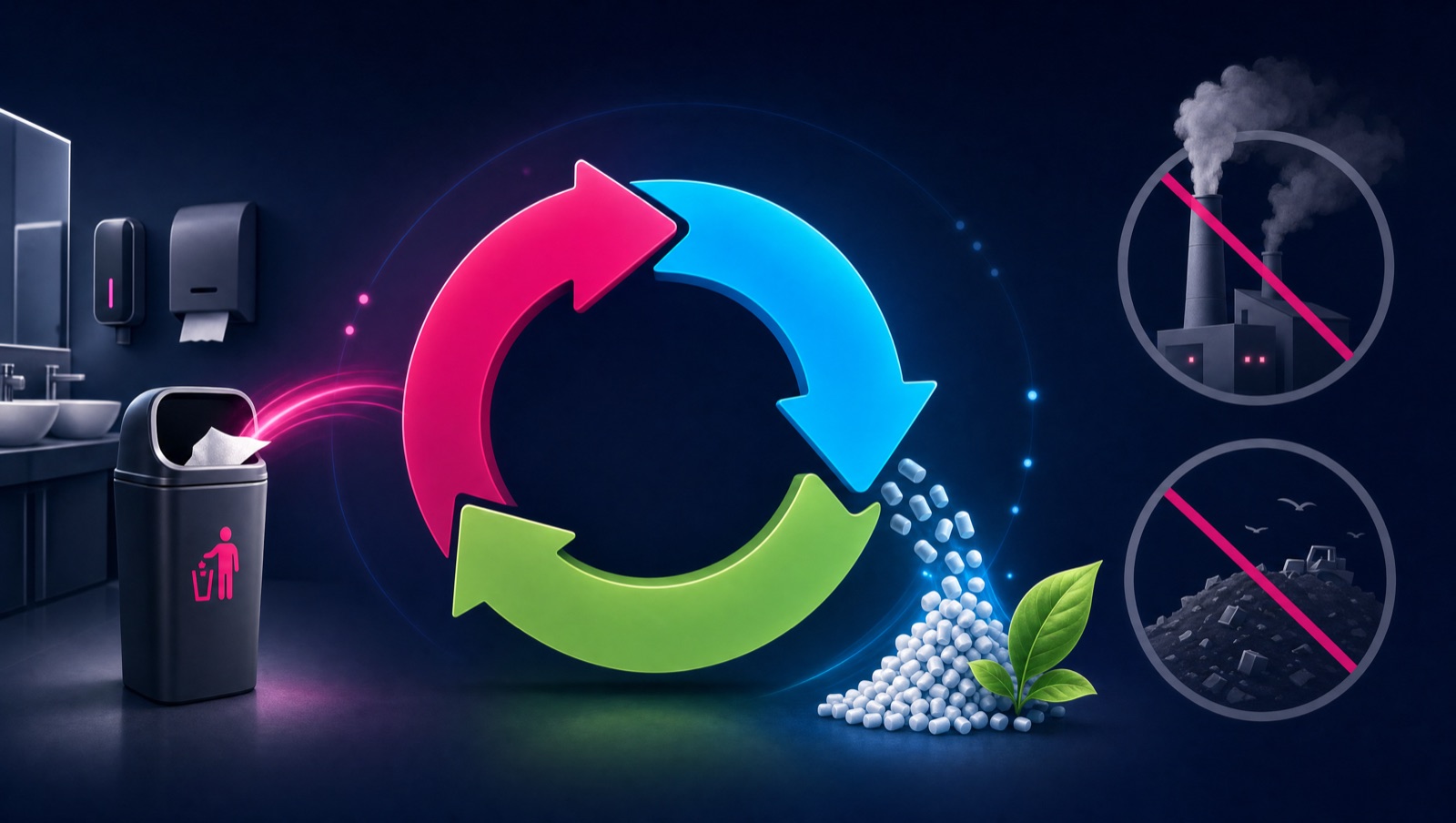
“Zero-to-landfill” has become a selling point across the waste management industry — and washroom services are no exception. But the term is often used loosely. Understanding what zero-to-landfill actually means, and how your washroom waste is processed, is essential if your organisation takes its environmental commitments seriously.
What Does Zero-to-Landfill Actually Mean?
At its simplest, zero-to-landfill means that none of the waste collected ends up in a landfill site. Instead, it is diverted to other processing methods. This matters: landfill is the least preferable option on the waste hierarchy, and decomposing waste in landfill releases methane, a potent greenhouse gas.
But the term says nothing on its own about how the diverted waste is processed. A genuine zero-to-landfill claim should be specific: it should name the facility, the processing method, and provide the duty of care documentation to back it up.
The Waste Hierarchy
The waste hierarchy is a legally enshrined framework (under the Waste (England and Wales) Regulations 2011) that ranks waste management options from most to least preferable:
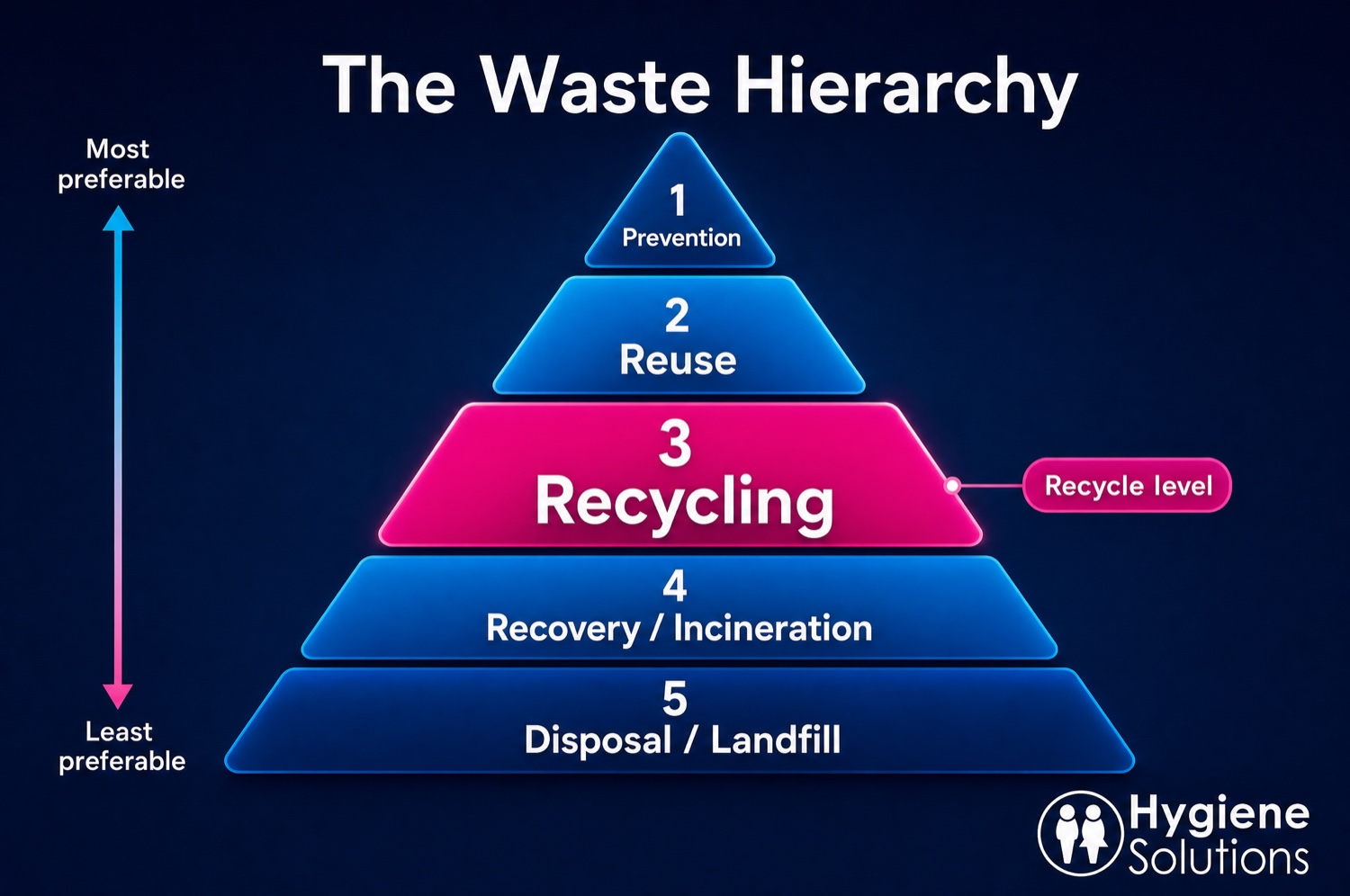
- Prevention — reducing waste in the first place
- Reuse — using items again for the same or different purpose
- Recycling — processing waste into new raw materials
- Recovery — extracting value from waste, typically as energy
- Disposal — landfill
Under duty of care regulations, organisations are required to apply the waste hierarchy when managing their waste, prioritising options towards the top wherever it is practical to do so.
Recovery: Turning Waste Into Energy
For mixed washroom waste — sanitary waste, nappy waste, and similar streams — recycling into new raw materials is rarely practical, because the materials are soiled, mixed, and difficult to separate cleanly. For these waste streams, energy recovery is the realistic and responsible alternative to landfill.
Energy recovery sits at the fourth level of the waste hierarchy. It captures usable energy from waste that would otherwise be buried, and it avoids the methane emissions that landfill produces. There are different routes to energy recovery, and one of the more efficient is the production of Solid Recovered Fuel (SRF).
What is Solid Recovered Fuel?
Solid Recovered Fuel is a processed fuel made from non-recyclable waste. The waste is treated, dried, and refined into a consistent fuel that can be used in energy generation, displacing fossil fuels such as coal and gas. Producing SRF turns waste into a usable resource and keeps it out of landfill entirely.
How Hygiene Solutions Processes Your Washroom Waste
At Hygiene Solutions, every sanitary bin, nappy bin, and washroom waste stream we collect is taken to our processing partner, Go 4 Greener in Derby. There, the waste is processed using Advetec biotechnology and converted into Solid Recovered Fuel (SRF) for energy recovery.
Here is what that means in practice:
- 100% of collected washroom waste is diverted from landfill — genuine zero-to-landfill
- Waste is converted into Solid Recovered Fuel (SRF) for energy recovery, displacing fossil fuels in energy generation
- Processing takes place locally in Derby, keeping the transport footprint low
- Every client receives an Eco Impact Report showing tonnage collected and diversion data
- Full duty of care documentation — an annual waste transfer note covering all collections, with proof-of-service emails after every visit
- The processing facility is named, licensed, and auditable
This approach has been a core part of our service since we first committed to zero-to-landfill processing, and it is one of the reasons organisations with strong ESG reporting requirements choose to work with us.
Avoiding Greenwashing: Questions to Ask
The washroom services sector has a greenwashing problem. Many providers market themselves as “eco-friendly” or “zero-to-landfill” without being transparent about where the waste actually goes. The solution is not to take claims at face value — it is to ask for specifics:
- Vague language — be wary of phrases like “responsibly disposed of” without any detail on the method
- No waste transfer documentation — a compliant provider should give you an annual duty of care waste transfer note covering all collections
- No named processing facility — if a provider cannot tell you the name and location of the facility processing your waste, question why
- No Eco Impact Report — reputable providers can supply data on the tonnage handled and the diversion achieved
If your current provider cannot answer these questions clearly, it may be time to review your arrangements.
Why This Matters for Your ESG Reporting
Environmental, Social, and Governance (ESG) reporting is becoming increasingly important for organisations of all sizes. Investors, clients, and regulators are scrutinising environmental claims more closely than ever.
If your ESG report makes a zero-to-landfill claim, it needs to be defensible. Genuine, documented zero-to-landfill processing gives you:
- Defensible data — backed by Eco Impact Reports with real tonnage and diversion figures
- Duty of care compliance — demonstrating you are meeting your obligations with proper documentation
- Landfill diversion — showing that none of your washroom waste is going to landfill, avoiding methane emissions
- Stakeholder confidence — transparent, specific reporting builds trust with investors, clients, and employees
Making the Switch
If you are currently using a washroom services provider whose waste destination is unclear, switching to a transparent, fully documented service is straightforward. Here is what to do:
- Ask your current provider — request written confirmation of the processing method and facility used
- Review your waste transfer notes — check whether the documentation is complete and consistent
- Compare providers — look for those who can name their processing facility and supply diversion data
- Book an audit — a free washroom site survey will assess your current arrangements and identify where improvements can be made
The Bottom Line
Zero-to-landfill is a meaningful commitment — but only when it is genuine, specific, and documented. Organisations that care about their environmental impact should be asking exactly where their washroom waste goes and what happens to it.
At Hygiene Solutions, every sanitary bin collection, nappy bin service, and washroom waste stream we handle is diverted 100% from landfill and converted into Solid Recovered Fuel through our Go 4 Greener partnership in Derby. If you would like to see what that looks like for your organisation, get in touch for a no-obligation conversation.