
If your premises have female employees, visitors, or members of the public using your washrooms, you have a legal obligation to provide sanitary waste disposal facilities. It sounds straightforward, but the regulations span several pieces of legislation, and non-compliance can result in fines, enforcement notices, and reputational damage.
This guide breaks down exactly what the law requires, who is responsible, and how to make sure your organisation stays on the right side of the regulations.
The Workplace (Health, Safety and Welfare) Regulations 1992
The primary piece of legislation governing sanitary bins in workplaces is the Workplace (Health, Safety and Welfare) Regulations 1992. Regulation 20 requires employers to provide adequate sanitary conveniences, and the associated Approved Code of Practice makes clear that suitable means of disposing of sanitary dressings must be available in female toilets.
In practical terms, this means every female cubicle in your workplace must have a pedal-operated sanitary bin that is:
- Hygienic — with a lid that closes fully
- Regularly serviced — emptied and sanitised on a set schedule
- Fit for purpose — not cracked, stained, or overflowing
There is no specific frequency mandated in the regulations, but industry best practice — and what the Health and Safety Executive (HSE) expects — is a minimum four-weekly service cycle. Higher-footfall washrooms may need more frequent collections.
The Education (School Premises) Regulations 1999
If you manage school premises, additional requirements apply under the Education (School Premises) Regulations 1999. Schools must provide appropriate sanitary facilities for pupils, and this includes disposal bins in cubicles used by female students.
For schools, there are further considerations:
- Sensitivity — bins should be discreet and easy for young people to use without embarrassment
- DBS-checked operatives — anyone servicing school washrooms must hold an enhanced Disclosure and Barring Service check
- Term-time scheduling — services should align with school calendars to avoid unnecessary visits during holidays
If your school procures washroom services through the ESPO framework, compliance with these requirements is built into the contract terms.
Environmental Protection Act 1990 and Duty of Care
Sanitary waste is classified as offensive waste under the Environmental Protection Act 1990. While it is not classed as hazardous, it still falls under strict duty of care requirements. As the waste producer, your organisation is legally responsible for ensuring that sanitary waste is:
- Collected by a licensed waste carrier — your provider must hold the appropriate Environment Agency permits
- Transported safely — in sealed, leak-proof containers
- Disposed of properly — at a licensed facility, with full documentation
This means you need to keep records. Your waste carrier should provide you with duty of care waste transfer notes, and you are required to retain these for a minimum of two years. If you cannot produce them during an inspection, you could face enforcement action.
The waste hierarchy matters
Under the duty of care regulations, organisations should follow the waste hierarchy, prioritising prevention, reuse, and recycling over recovery and landfill. If your ESG targets call for genuine zero-to-landfill processing, check exactly what your provider does with the waste after collection — and ask them to name the processing facility.
What Happens If You Are Non-Compliant?
Non-compliance with sanitary bin regulations can lead to several outcomes:
- HSE enforcement notices — requiring you to remedy the breach within a set timeframe
- Improvement or prohibition notices — in serious cases, the HSE can require you to stop using affected facilities until they meet standards
- Fines — prosecution for failing to comply with workplace welfare regulations can result in unlimited fines
- Local authority action — environmental health officers can issue notices under the Environmental Protection Act for waste duty of care breaches
- Reputational damage — poor washroom conditions reflect badly on your organisation, affecting staff morale, recruitment, and client perceptions
It is worth noting that the HSE does carry out inspections, and washroom facilities are checked as part of broader workplace welfare assessments. Local authorities can also inspect waste documentation at any time.
How to Ensure Compliance
Staying compliant does not need to be complicated. Here is a practical checklist:
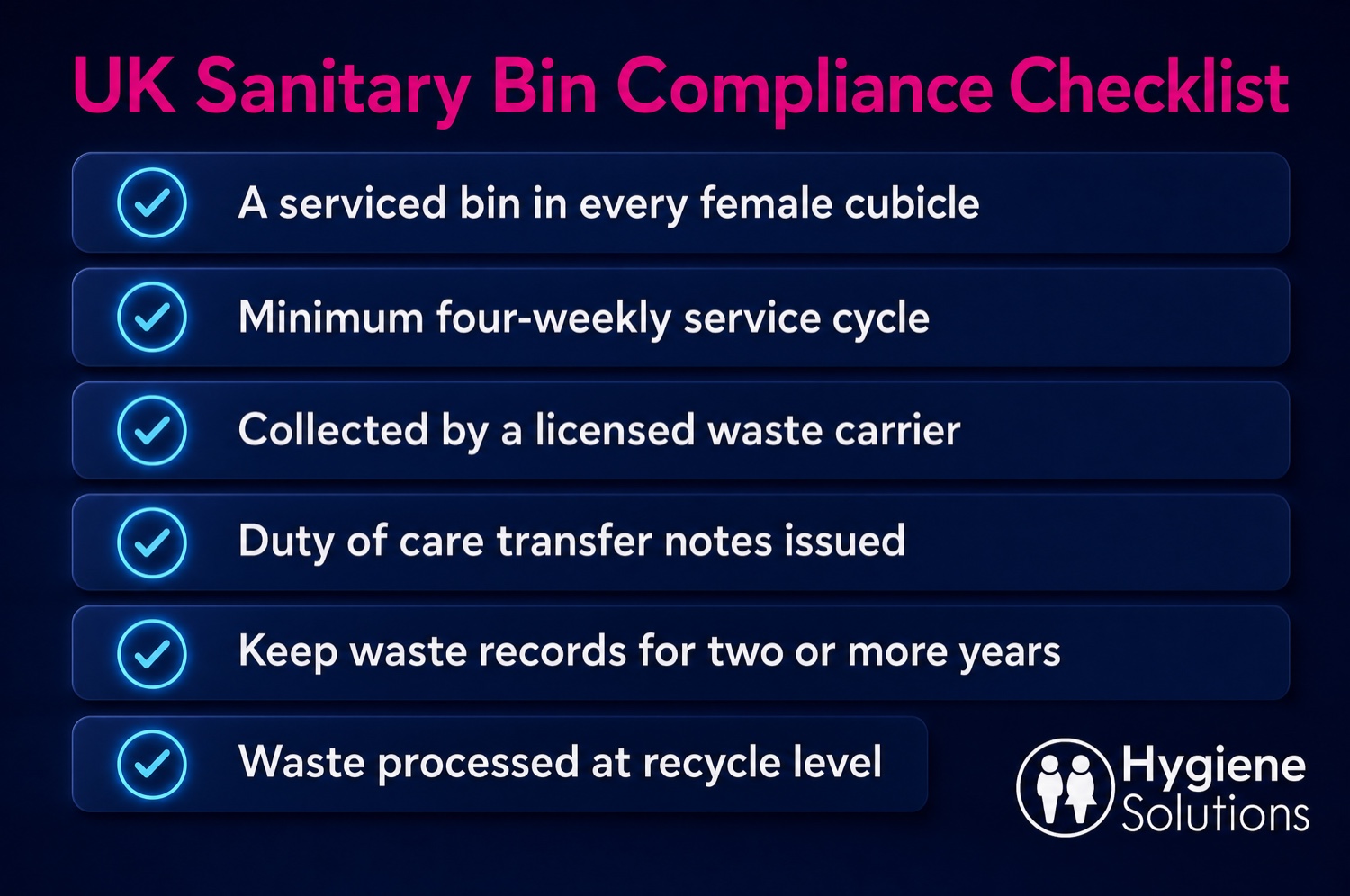
- Audit your current provision — check every female cubicle has a working, hygienic sanitary bin. A free washroom site survey can identify gaps quickly.
- Verify your provider’s credentials — ensure they hold Environment Agency waste carrier licences and, if applicable, DBS clearance for school sites.
- Confirm the service cycle — four-weekly as a minimum, with the option to increase frequency for busy washrooms.
- Check waste destination — ask your provider where the waste goes and at what level of the waste hierarchy it is processed.
- Keep your paperwork — file duty of care waste transfer notes for at least two years.
- Review regularly — regulations and best practice evolve. Schedule an annual review of your washroom compliance.
Choosing the Right Sanitary Bin Service
Not all sanitary bin services are equal. When comparing providers, look beyond price and consider:
- Service reliability — missed collections leave you exposed
- Waste processing method — genuine zero-to-landfill, with a named processing facility
- Documentation — automatic provision of duty of care paperwork
- Equipment quality — modern, hygienic bins that meet current standards
- Accreditations — ISO 9001, Safe Contractor, and framework agreements like ESPO demonstrate credibility
At Hygiene Solutions, we have been providing compliant sanitary bin services since 1999. Every collection includes full duty of care documentation, and our washroom waste is diverted 100% from landfill — processed into Solid Recovered Fuel (SRF) for energy recovery through our Go 4 Greener partnership in Derby.
Summary
UK sanitary bin regulations are clear: if you have female washroom users, you must provide adequate, hygienic disposal facilities. The legal framework spans the Workplace Regulations 1992, Education Regulations 1999, and the Environmental Protection Act 1990, and your obligations extend from the bin in the cubicle all the way to final waste disposal.
The good news is that compliance is straightforward with the right provider. If you are unsure about your current setup, book a free washroom site survey and we will assess your provision against current regulations at no cost.